
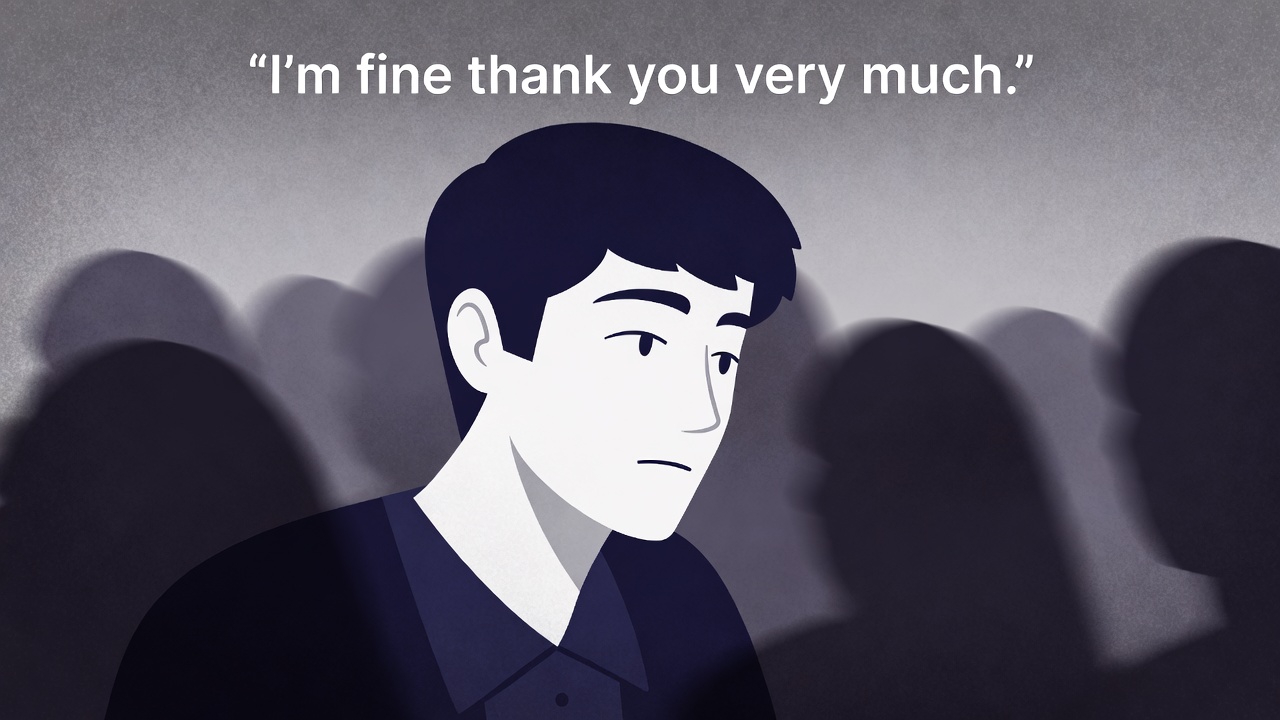
The Most Dangerous Lie
I became an expert at saying “I’m fine.” It rolled off my tongue effortlessly, polished by years of repetition, perfected through countless conversations where honesty felt too dangerous. Friends asked, coworkers checked in, family members worried — and every single time, I gave them the same carefully constructed answer. A small smile. A calm tone. A gentle shrug. “I’m fine.” What they never saw was the war happening behind my eyes, the exhaustion that weighed down my chest, and the quiet panic that followed me into every silent moment. I said it so often that eventually, even I started to believe it. And maybe that was the most dangerous part — convincing myself that survival meant pretending I wasn’t drowning.
On the outside, my life looked stable, even enviable. I had responsibilities, routines, goals, and a future I was supposedly working toward. I showed up. I delivered. I smiled when expected. I laughed when appropriate. I nodded at the right moments and offered comfort when others needed it, all while quietly falling apart inside. I became the reliable one, the strong one, the person who never needed help. People admired my resilience, not realizing it was built on denial, fear, and an endless attempt to outrun my own emotions. Every compliment about my strength felt like a misunderstanding I didn’t have the courage to correct.
The truth was, I was exhausted in ways sleep could never fix. My body moved through days automatically, but my mind never rested. Every night, I lay awake replaying old conversations, regrets, missed opportunities, and painful memories I had buried deep. I carried invisible weights that pressed against my chest until breathing itself felt like work. Some days, even simple tasks felt overwhelming, yet I forced myself to keep going because stopping meant facing the truth. And the truth was something I had been avoiding for years — that I was deeply unhappy, deeply lonely, and deeply afraid of admitting it.
I learned early on that vulnerability made people uncomfortable. Whenever I hinted at sadness, the room grew awkward. Conversations shifted. Advice replaced empathy. So I adapted. I hid. I minimized my pain, turning real suffering into jokes, shrugging off emotional wounds as if they were nothing more than small inconveniences. Slowly, I trained everyone around me — and myself — to believe that I was always okay. But pretending requires energy, and the longer I pretended, the heavier the performance became. Each forced smile felt heavier than the last, each “I’m fine” another brick added to the wall I was building around my heart.
There were moments when I almost told the truth. Times when someone looked at me a little longer, when their voice softened with concern, when their question carried genuine care. In those moments, my throat tightened and my chest burned, but the words never came. Fear always won. Fear of being judged. Fear of being misunderstood. Fear of being seen as weak. Fear of becoming a burden. So instead, I swallowed my honesty and handed them the same familiar lie. I watched relief flicker across their faces, unaware that I had just abandoned myself once again.
What I was hiding wasn’t just sadness — it was grief, disappointment, anxiety, shame, and a constant sense that I was falling behind in life. I mourned versions of myself that never got to exist. I carried heartbreaks no one knew about. I lived with questions that haunted me daily: Was I enough? Was I wasting my life? Would anyone stay if they saw the real me? These thoughts circled endlessly, feeding a quiet despair that grew stronger with every year I stayed silent. And yet, I kept smiling, kept performing, kept surviving — mistaking endurance for healing.
Over time, the mask stopped feeling like something I wore and started feeling like who I was. I forgot how to express pain without apologizing for it. I forgot how to ask for help without feeling guilty. I forgot what it felt like to be truly seen. My emotional world shrank into a private prison where I was both the guard and the captive. And the scariest realization of all was that no one was forcing me to stay there anymore — I was choosing it, because hiding had become safer than hoping.
But silence has a cost. It seeps into your bones, erodes your joy, and slowly drains your ability to feel alive. Each day I said “I’m fine,” a small part of me disappeared. I lost excitement. I lost curiosity. I lost the ability to dream freely. I existed in survival mode, measuring life in obligations instead of meaning. And somewhere along the way, I stopped living for myself and started living only to avoid disappointing others. The lie protected them from discomfort — but it destroyed me quietly.
The breaking point didn’t arrive in a dramatic explosion. There was no single moment, no obvious collapse. Instead, it came as a slow, unbearable heaviness, a realization that I could not carry this version of myself any longer. One night, alone in the dark, I whispered the truth out loud for the first time: I am not fine. The words trembled in the air, fragile yet powerful, and something inside me cracked open. It was the beginning of honesty. And the beginning of everything I had been hiding finally demanding to be seen.
The Trauma I Learned to Minimize
For a long time, I convinced myself that what I had lived through didn’t count as trauma. Other people had worse stories, deeper scars, more visible wounds, and so I told myself that my pain was small, insignificant, unworthy of attention. I compared my experiences to those who had suffered more dramatically, and in doing so, I slowly erased my own struggles. Every time a memory surfaced, I pushed it down with logic, telling myself to be grateful instead of honest. I became skilled at shrinking my pain, compressing it into something manageable, something I could carry quietly without disturbing anyone else. But pain does not disappear when it is minimized — it simply waits, patient and persistent, until it finds another way to be heard.
Some of my earliest lessons were learned in silence. I grew up understanding that emotions were inconveniences, problems to be solved quickly rather than experiences to be felt fully. When I was hurt, I was encouraged to move on. When I was sad, I was reminded to be strong. When I was overwhelmed, I was told to endure. Slowly, I learned that expressing pain made me difficult, and I did not want to be difficult. I wanted to be easy to love, easy to deal with, easy to keep. So I trained myself to swallow my emotions and present only the parts of me that felt acceptable. The rest — the fear, the confusion, the heartbreak — I stored away, convinced that ignoring them was a form of maturity.
There were moments that should have broken me, moments that reshaped how I saw myself and the world, but I brushed them aside as if they were nothing more than unfortunate events. Losses I never grieved. Betrayals I never confronted. Words that cut deeply, lingering long after they were spoken. Each experience layered itself onto the last, building a quiet mountain of unresolved emotion inside my chest. I carried it so long that its weight felt normal, like something I was simply meant to live with. I forgot what lightness felt like. I forgot what emotional safety felt like. I forgot what it meant to move through life without constantly bracing myself for the next blow.
What hurt the most wasn’t always the trauma itself, but the loneliness of carrying it alone. I longed to be understood, yet feared that sharing would make me seem broken. I wanted comfort, yet believed I had no right to ask for it. So I remained silent, trapped between craving connection and protecting my carefully constructed image of strength. Each time I dismissed my pain, I sent myself the message that I didn’t deserve care. Over time, that belief seeped deep into my identity, shaping how I treated myself in moments of struggle. I became harsh, impatient, and dismissive toward my own suffering, holding myself to impossible standards while offering compassion freely to everyone else.
At night, the memories returned. In the stillness, when distractions faded, the past resurfaced in fragments — half-remembered conversations, blurred images, emotional echoes that refused to settle. My chest tightened as if my body remembered what my mind tried to forget. Sleep became restless, filled with unease rather than rest. Mornings arrived too quickly, demanding energy I no longer had. And yet, I continued to show up, to perform, to deliver — because the world rewarded functionality, not honesty. As long as I kept moving, no one asked questions. As long as I smiled, no one worried. And so I kept running, hoping that motion alone could outrun memory.
The longer I minimized my trauma, the more it reshaped my relationships. I became distant without meaning to, guarded without realizing it. I struggled to trust, struggled to relax, struggled to fully let people in. Every connection carried the fear of abandonment, of disappointment, of rejection. I expected pain even in moments of joy, bracing myself for loss before happiness could fully arrive. My heart stayed half-closed, protecting itself from potential harm while quietly longing for closeness. And the cruel irony was that the walls I built to protect myself were the same walls that kept love from reaching me.
Eventually, my body began to protest in ways my words never could. Fatigue clung to me no matter how much I rested. My thoughts raced, yet my motivation faded. My chest felt tight, my breath shallow, my patience thin. Anxiety became my constant companion, whispering worst-case scenarios into every quiet moment. Still, I told myself I was fine. Still, I dismissed these signs as stress, as overwork, as temporary discomfort. I refused to acknowledge that my mind and body were begging for something I had denied myself for years — acknowledgment, gentleness, and healing.
It took me a long time to understand that trauma does not need to be dramatic to be devastating. It does not require headlines or tragedy to leave deep marks. Sometimes, it grows from years of emotional neglect, unspoken pain, unmet needs, and silent endurance. Sometimes, it lives in the spaces where comfort should have been, in the absence of safety, in the lack of permission to feel. And sometimes, the most harmful wounds are the ones we convince ourselves do not exist.
Learning to validate my own pain felt unnatural, almost forbidden. It meant challenging beliefs I had carried since childhood, beliefs that equated worth with endurance and love with compliance. It meant admitting that I had been hurt — deeply, repeatedly, and quietly. And that admission terrified me, because it forced me to confront everything I had been running from. But it also cracked open a door, offering the first glimpse of a different way to live — one where my feelings mattered, where my story deserved space, and where healing could finally begin.
The Loneliness No One Noticed
Loneliness doesn’t always look like isolation. Sometimes it looks like crowded rooms, busy schedules, constant conversations, and a phone full of messages. My life was full of noise, yet inside, everything was painfully quiet. I was surrounded by people but deeply alone, moving through days without ever feeling truly seen. I laughed in groups, contributed to discussions, showed interest in other people’s lives, and offered support whenever it was needed. But no one ever asked about the parts of me that hurt, and I never volunteered them. I became skilled at blending in, at being present without actually revealing myself, at existing without belonging. And slowly, invisibly, loneliness wrapped itself around my heart.
There is a unique kind of sadness that comes from being known only on the surface. People recognized my name, my face, my role, my reliability — but not my fears, my doubts, my silent struggles. Conversations skimmed across shallow waters, never diving into the depths where my real thoughts lived. I longed for someone to ask the questions that mattered, to sit with me in the uncomfortable truths, to notice the heaviness behind my smiles. Yet I also feared those moments, because being seen meant being vulnerable, and vulnerability felt dangerous. So I stayed hidden, caught in a cycle of wanting connection and running from it at the same time.
Some nights, the loneliness became unbearable. I would lie awake, staring into the darkness, feeling as though the world had gone on without me, as though I was standing still while everyone else moved forward. My thoughts drifted to memories, regrets, and imagined futures, weaving together into a painful tapestry of what-ifs and maybes. I questioned my worth, my choices, my purpose, wondering how I had ended up feeling so disconnected from my own life. The silence of those hours pressed heavily against my chest, amplifying every insecurity I carried. And yet, when morning came, I pulled myself together, wiped away the exhaustion, and stepped back into my carefully crafted role.
I became the listener, the supporter, the dependable one — the person others leaned on when they needed strength. And while offering comfort brought me brief moments of connection, it also deepened my loneliness. I gave endlessly, hoping that someday someone would notice my emptiness and reach back. But people rarely look for cracks in those who appear strong. They assume stability, resilience, emotional self-sufficiency. They trust the performance. And so I remained unseen, trapped behind the image I had built so carefully, longing to be known but terrified of the cost.
Social gatherings felt increasingly exhausting. I smiled, nodded, laughed, and participated, but every interaction drained me further. It felt like I was constantly performing, playing a role I no longer recognized as myself. I studied people’s faces, searching for signs of genuine curiosity, for invitations into deeper conversation, for permission to be honest. But the moments never came. Everyone was busy, distracted, consumed by their own worries and responsibilities. And I couldn’t blame them — I had made it easy for them not to notice. I had trained the world to believe I was fine.
The loneliness seeped into my self-perception, reshaping how I saw myself. I began to believe that my struggles were boring, that my pain was unremarkable, that my story was unworthy of attention. I convinced myself that no one would truly care, even if I spoke. So I stayed quiet, shrinking my emotional presence until it barely took up space. Over time, I learned how to disappear in plain sight, to exist without leaving emotional footprints, to be part of everything and connected to nothing.
Even in moments of happiness, loneliness lingered like a shadow. Achievements felt hollow without someone to share them with honestly. Joy felt incomplete without emotional intimacy. I could celebrate, but not fully. I could smile, but not freely. Every positive experience carried an undercurrent of longing — for closeness, for understanding, for a connection that went beyond surface-level exchanges. I wanted someone to know my history, my fears, my contradictions, and still choose to stay. But wanting and believing are two very different things.
Loneliness taught me harsh lessons about emotional survival. It taught me to rely only on myself, to suppress my needs, to lower my expectations of others. It hardened parts of me that once felt soft and open. I became cautious with my trust, selective with my vulnerability, guarded with my emotions. Each disappointment added another layer of protection, another reason to stay hidden. And yet, despite all the walls I built, my heart never stopped yearning for connection. It beat quietly, persistently, holding onto hope even when logic told me to let go.
Looking back, I realize that the loneliness I carried was not just about the absence of others — it was about my absence from myself. I had disconnected from my own emotions, my own needs, my own truth. In trying to protect myself from pain, I had also protected myself from intimacy, belonging, and love. And the longer I stayed in that emotional isolation, the more foreign genuine connection became.
But something inside me began to shift. The loneliness became too heavy to ignore, too persistent to dismiss. It demanded attention. It forced me to confront the truth that I could no longer survive on autopilot, no longer hide behind polite smiles and empty reassurances. It whispered a painful but necessary realization: I could not heal in isolation. And if I wanted to feel alive again, I would have to risk being seen.
The Fear of Being Truly Known
There is a difference between being seen and being known, and for most of my life, I allowed people to see only what I carefully curated. I showed them the version of myself that felt safe, polished, and acceptable, while hiding the parts that trembled with uncertainty, fear, and longing. I let them glimpse my achievements, my strengths, my humor, my reliability — but never my doubts, my insecurities, my quiet breakdowns. I believed that if anyone truly knew me, they would find me lacking, disappointing, or too complicated to love. So I stayed hidden, convincing myself that partial visibility was better than complete rejection.
The fear of being truly known grew slowly, shaped by years of subtle emotional lessons. Every time vulnerability was met with discomfort, dismissal, or misunderstanding, I learned to retreat. Every time honesty was followed by awkward silence or quick advice instead of empathy, I learned to shut down. Over time, I internalized the idea that my deeper emotions were inconvenient, messy, and unwelcome. I started filtering my thoughts before they reached my lips, editing my feelings until they sounded more reasonable, more digestible, more acceptable. Eventually, I no longer needed to censor myself consciously — the restraint became automatic, a reflex I barely noticed.
Even in my closest relationships, I maintained emotional distance. I shared stories, but not feelings. I explained events, but not their impact. I discussed life, but not my inner world. I kept conversations safe, steering them away from anything that might reveal too much of my vulnerability. People believed they knew me well, and in many ways, they did — but only the surface. Beneath that surface lived a complexity I never allowed anyone to explore. I feared that if someone stepped too close, they would discover how fragile I really was, and once that fragility was exposed, I would lose the respect, admiration, and security I had built my identity around.
The idea of being fully known terrified me because it meant surrendering control. It meant allowing someone else to see my flaws, my contradictions, my unresolved pain, and my uncertainty about who I was becoming. It meant risking rejection in its most devastating form — the rejection of my true self. I could handle criticism of my work, my decisions, even my mistakes, but I did not believe I could survive the rejection of my essence. So I protected myself by staying partially hidden, giving just enough to maintain connection while keeping the most sensitive parts of my heart safely out of reach.
Yet, hiding came with its own cost. The deeper my fear grew, the more isolated I became. I longed for intimacy, for emotional safety, for a space where I could exist without performance or pretense. But every time I approached that possibility, panic pulled me back. I worried that honesty would change how people saw me, that vulnerability would disrupt the balance of my relationships, that authenticity would make me difficult to love. So I stayed silent, trapped between craving closeness and fearing exposure, never fully satisfied and never fully at peace.
There were moments when the truth nearly spilled out — times when exhaustion lowered my defenses and emotion pressed hard against my chest. In those moments, I could feel the words gathering behind my teeth, ready to escape. My heart pounded, my breath shortened, and my body tensed, bracing for impact. But fear always intervened, reminding me of the risks, replaying past disappointments, warning me of potential rejection. And so, once again, I swallowed my truth and replaced it with silence, telling myself that self-protection was wisdom.
The longer I lived this way, the more fragmented I felt. It was as if I were split into two versions of myself — the one the world saw and the one I carried in secret. The public version was confident, capable, composed. The private version was tired, uncertain, emotionally overwhelmed, and desperately craving relief. Maintaining that divide required constant effort, and over time, the exhaustion became unbearable. I felt like I was living a double life, performing a role that no longer aligned with who I truly was. And yet, stepping out of that role felt like stepping off a cliff.
I began to realize that my fear of being known was rooted in a deeper belief — that love was conditional. That acceptance had to be earned through strength, productivity, emotional control, and usefulness. I believed that if I stopped performing, if I revealed my struggles, I would lose my worth in the eyes of others. This belief shaped every interaction, every relationship, every emotional choice I made. It kept me striving, pleasing, and enduring, even when my soul begged for rest and understanding.
But slowly, painfully, a new awareness began to emerge. I started to question whether the connections I had built while hiding were truly connections at all. If people only loved the version of me I performed, did they really love me? If I never allowed myself to be fully seen, was I even giving others the chance to know me? These questions unsettled me, shaking the foundation of the emotional world I had constructed. They forced me to confront the possibility that my fear, while protective, was also imprisoning.
The desire to be known — truly, deeply, authentically known — began to outweigh the fear. I grew tired of carrying myself alone. I wanted to experience relationships that felt real, not rehearsed. I wanted to speak without filtering, to feel without apologizing, to exist without constant self-monitoring. And for the first time, I allowed myself to imagine a life where I did not have to hide — where honesty could replace performance, and vulnerability could become a bridge instead of a threat.
That realization marked a quiet turning point. I did not change overnight. I did not suddenly become fearless or emotionally open. But something inside me softened. The walls I had built so carefully began to crack, allowing small streams of honesty to seep through. And with each small act of courage, I felt a little lighter, a little freer, a little closer to the person I had been hiding for so long.
When My Body Started Screaming
For years, my mind carried the weight of everything I refused to face, but eventually, my body could no longer stay silent. It began with small signals — exhaustion that sleep could not cure, tension that never fully released, headaches that lingered longer than they should. I dismissed these signs as stress, telling myself I was simply tired, busy, or overwhelmed like everyone else. I pushed forward, ignoring the growing discomfort, convinced that persistence was strength. But my body was not asking for persistence. It was begging for attention, for gentleness, for care.
The fatigue deepened until even simple tasks felt monumental. Getting out of bed became a negotiation. Concentration slipped through my fingers. My chest often felt tight, as though I were breathing through resistance, and my heart raced without warning, reacting to threats that existed only in my mind. Anxiety settled into my muscles, keeping them perpetually tense, braced for impact. I lived in a constant state of alertness, my nervous system unable to relax, as if danger were always just around the corner. And yet, I continued to say, “I’m fine,” even as my body quietly unraveled.
Sleep offered little relief. Nights became restless, filled with shallow dreams and sudden awakenings. My thoughts raced in endless loops, replaying conversations, worrying about tomorrow, revisiting mistakes from years ago. Silence felt unbearable, forcing me to confront everything I had buried. Some nights, I lay in the darkness, staring at the ceiling, my heart pounding, my breath uneven, my mind screaming for peace. Morning always arrived too soon, demanding energy I no longer had, pushing me back into routines that felt increasingly impossible to maintain.
The physical symptoms multiplied, each one a message I refused to read. Digestive issues, unexplained aches, constant tension in my shoulders and neck, a heaviness in my chest that mimicked grief — all of it woven together by chronic emotional suppression. Doctors found nothing alarming. Tests came back normal. On paper, I was healthy. But inside, I felt anything but. The absence of a diagnosis left me feeling both relieved and defeated, because it meant there was no simple explanation, no easy fix, no pill that could restore what had been slowly draining from me for years.
I began to fear my own body, unsettled by its unpredictability. Panic attacks arrived without warning, stealing my breath and clarity in public spaces, leaving me shaking in bathroom stalls and quiet corners. My heart pounded violently, my hands trembled, and my thoughts spiraled into worst-case scenarios. In those moments, I felt fragile, exposed, and deeply ashamed. I worried that others would see my unraveling, that my carefully constructed image of strength would finally collapse. So I hid these episodes, recovering in silence, wiping away tears, straightening my posture, and stepping back into the world as if nothing had happened.
The disconnect between how I appeared and how I felt grew unbearable. I lived in a constant state of contradiction — outwardly functional, inwardly falling apart. Each day required more effort than the last, draining my emotional reserves until nothing remained. I felt hollow, depleted, disconnected from joy, hope, and even sadness. Numbness replaced emotion, offering temporary relief from pain while stealing my capacity to feel alive. I moved through life as though underwater, aware of everything around me yet unable to fully engage with it.
Eventually, my body forced a reckoning. One day, I broke down in a way I could not contain. The tears came uncontrollably, my breath shattered into sobs, and the exhaustion I had ignored for years surged forward all at once. In that moment, I realized how long I had been fighting myself, how desperately I had tried to outrun my own humanity. I saw the cost of my silence, the damage of my endurance, the harm of my relentless self-neglect. And for the first time, I allowed myself to admit what my body had been saying all along — I could not continue this way.
That breakdown, as terrifying as it was, became a turning point. It stripped away my illusions of control and forced me to confront the reality of my emotional landscape. I could no longer pretend that my struggles were temporary, manageable, or insignificant. I had to acknowledge the depth of my pain, the weight of my exhaustion, and the urgency of my need for change. In doing so, I began to understand that healing is not a luxury, but a necessity — not a reward for endurance, but a requirement for survival.
Listening to my body required a level of honesty I had avoided for most of my life. It meant slowing down, saying no, resting without guilt, and asking for help without shame. It meant allowing myself to be imperfect, fragile, and uncertain. These changes felt unnatural, almost wrong, at first, challenging deeply rooted beliefs about productivity, strength, and worth. But slowly, they opened a space for compassion, both toward myself and others. I began to treat my struggles not as failures, but as signals — invitations to care rather than reasons to judge.
In learning to listen, I also learned to forgive. I forgave myself for the years of neglect, for the silence, for the fear that kept me hidden. I recognized that I had done the best I could with the tools I had, and that survival, in any form, deserves gentleness. My body, once a battlefield, slowly became a guide, teaching me when to pause, when to breathe, when to soften. And though the journey toward healing was far from linear, it finally felt honest.
Learning to Say “I’m Not Okay”
Saying “I’m not okay” felt like learning a new language. The words were simple, yet terrifying, heavy with vulnerability and risk. For years, I had built my identity around strength, resilience, and self-sufficiency, and now I was being asked to dismantle that carefully constructed image. The first time I tried to speak the truth, my voice shook, my throat tightened, and my chest burned with emotion. I feared that admitting my struggle would make me weak, difficult, or burdensome. But what I discovered instead was something I had never allowed myself to experience before — relief.
Letting the truth out felt like releasing a breath I had been holding for decades. The words created space inside me, easing the constant tension that had lived in my body for so long. I realized how much energy I had spent hiding, filtering, and protecting myself from judgment. Honesty, though frightening, felt lighter than silence. Each time I shared even a small fragment of my reality, I felt a little less alone. The shame I had carried so quietly began to loosen its grip, replaced by a cautious sense of permission — permission to feel, to struggle, to exist as I was rather than as I believed I should be.
Some people responded with compassion, understanding, and warmth. Others felt uncomfortable, unsure how to react, eager to fix rather than simply listen. Both reactions taught me important lessons. I learned that not everyone is capable of holding vulnerability, and that this does not mean my truth is too heavy. It simply means that emotional depth requires emotional readiness. I learned to choose carefully who I trusted, to seek out those who listened without judgment, who offered presence instead of solutions, who allowed silence to coexist with pain. These relationships became sanctuaries — spaces where I no longer had to perform.
As I practiced honesty, I began to reconnect with myself. I learned to recognize my emotional signals, to honor my boundaries, and to respect my limits. I allowed myself rest without guilt, solitude without shame, and joy without fear. I started paying attention to what my body and heart needed rather than what the world expected. Slowly, I rebuilt a relationship with myself rooted in kindness instead of criticism, curiosity instead of judgment, and patience instead of urgency. This internal shift transformed how I moved through life, replacing survival mode with intentional living.
Healing did not erase my past, nor did it instantly quiet the fears I had carried for so long. Some days were still heavy, some nights still restless. But now, I faced them with honesty rather than avoidance. I allowed myself to cry when I needed to, to pause when I felt overwhelmed, and to ask for support when the weight became too much. Each act of self-compassion became a quiet rebellion against the beliefs that had kept me silent. Each moment of vulnerability became proof that I was learning how to live differently.
I began to understand that strength is not the absence of pain, but the courage to acknowledge it. Real resilience is not endurance, but adaptation. True healing is not perfection, but presence. These realizations softened the harsh expectations I had placed on myself, allowing room for imperfection and growth. I no longer needed to be invincible. I only needed to be honest. And in that honesty, I found a deeper, steadier form of strength than I had ever known.
Learning to say “I’m not okay” reshaped my relationships as well. It invited deeper conversations, fostered emotional intimacy, and built connections rooted in authenticity. I discovered that vulnerability creates bridges, not burdens. When I allowed myself to be seen, others felt safer revealing their own struggles. Our shared humanity replaced isolation, reminding us that none of us are meant to carry life alone. In those moments of mutual honesty, I found the belonging I had long searched for.
Now, when someone asks how I am, I pause before answering. I check in with myself. I choose honesty over habit. Sometimes I still say I’m fine — but only when it is true. Other times, I allow myself to say, “I’m struggling,” or “Today is hard,” or “I’m not okay.” And in those words, I feel something that once seemed impossible — freedom. Freedom from performance. Freedom from silence. Freedom from the exhausting lie I lived for so many years.
Because the truth is, I was never meant to survive life alone. None of us are. We are meant to feel, to connect, to stumble, to heal, and to grow together. And while I may never fully escape the shadows of my past, I now walk forward carrying light instead of denial, compassion instead of shame, and hope instead of fear. For the first time, I am not just existing — I am living.